
Menopause - Part 1
The Menopause Shift

Part 1: The Menopausal Shift
Menopause is one of the most significant biological transitions a woman experiences in her lifetime, yet many move through it without clear guidance, compassionate education, or supportive context.
This song (about how they don’t study the female body) goes through my head a lot whenever I write about Perimenopause and Menopause.
Very very very very little money is spent on researching a time of life that 51% of the population will go through. Maybe, just maybe, could they throw some of that money spent on erectile dysfunction our way?
And worse, instead of being recognized as a time of recalibration and renewal, menopause is too often framed as a period of decline. Something to dread, delay, or “fix.”
Let’s change that.
In this first section, we’ll explore what menopause really is, including what’s happening with your hormones, how those changes impact your sexual health and nervous system, and why understanding this transition is key to reclaiming your strength, vitality, and self-trust.
What Is Menopause…Really?
Technically, menopause is one day. Often a day you didn’t notice. It’s the 365th day since your last period. But, that’s only the medical term.
In real life, Menopause isn’t just a moment, it’s a multi-year physiological shift. It involves a gradual winding down of the hormonal cycles that have governed much of your body’s rhythm and function since puberty.
Here’s how the transition typically unfolds:
Perimenopause is the phase leading up to menopause, often beginning in a woman’s 40s (and sometimes late 30s). Hormones begin to fluctuate and become less predictable. Periods may become irregular, and early symptoms, such as disrupted sleep, mood swings, or heavier or lighter cycles, begin to appear.
Menopause is officially defined as having gone 12 consecutive months without a menstrual period. The average age is 51, but it can vary widely.
Postmenopause is the stage that follows. Hormones settle into a new baseline, and the body begins to adapt to life beyond the reproductive years.
Throughout this transition, estrogen, progesterone, and testosterone gradually decline, but not in a smooth or predictable way. These fluctuations are what cause many of the symptoms women experience, from night sweats to brain fog to a sudden loss of sexual desire.
It’s important to recognize that menopause is a biological recalibration. Just like puberty marked the entrance into reproductive life, menopause marks the transition into a different kind of power.
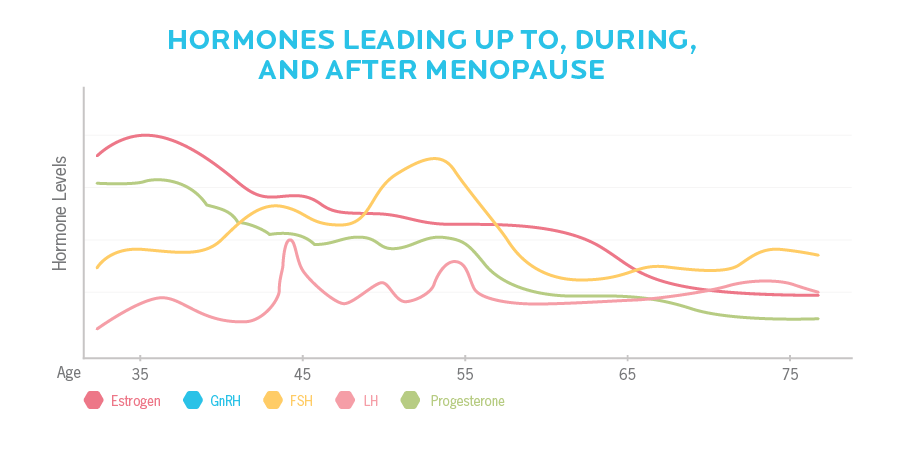
The Hormones: Estrogen, Progesterone & Testosterone
Hormones act like chemical messengers. They don’t just influence reproduction and your period, they affect your brain, metabolism, mood, immune system, muscle mass, cardiovascular function, and even how you process stress.
This means, menopause affects your body as a whole…and so we need to look at it holistically.
Estrogen
Estrogen is the most well-known female hormone, but its influence goes far beyond the menstrual cycle.
Supports cognitive function, memory, and mood
Maintains vaginal tissue, skin elasticity, and joint lubrication
Regulates bone density, cholesterol, and blood sugar
Influences thermoregulation (your body’s ability to manage heat)
As estrogen declines, you may experience hot flashes, vaginal dryness, joint aches, increased belly fat, changes in cholesterol, and issues with blood sugar regulation.
Progesterone
Often called the “calming hormone,” progesterone plays a key role in emotional balance and sleep. This is often the first hormone to start fluctuating, and is often to blame for the early perimenopausal symptoms.
Supports GABA, a neurotransmitter that promotes calm and relaxation
Helps maintain healthy sleep cycles
Balances the effects of estrogen
Reduces inflammation and anxiety
Low progesterone can lead to insomnia, heightened anxiety, and more intense premenstrual symptoms.
Testosterone
Though present in smaller amounts in women, testosterone plays an essential role in:
Supporting muscle mass and strength
Fueling libido and sexual response
Promoting confidence, drive, and motivation
Declining testosterone can lead to low energy, decreased muscle tone, and a noticeable dip in sexual desire.
Sexual Health…Often Overlooked
Sexual health is one of the most under-discussed aspects of menopause, yet it profoundly impacts quality of life, confidence, and self-connection. Many women report feeling confused or even ashamed by the changes they experience in this area, thinking they’ve “lost” something essential. But once again: this is a change…and there is support.
What’s Changing, and Why:
Vaginal dryness and thinning: Estrogen helps maintain the thickness, elasticity, and lubrication of vaginal tissue. As it declines, the tissue becomes thinner, drier, and more fragile. This can lead to discomfort during sex, irritation, or even minor tearing.
Decreased libido: Loss of desire is common, but it’s often due to a combination of hormonal, neurological, emotional, and relational factors (not just “low estrogen.”) Fatigue, stress, body image shifts, and changing relational dynamics all contribute.
Pelvic floor changes: Estrogen also supports collagen production and muscle tone in the pelvic region. With less of it, you may experience urgency, leaking, or a feeling of heaviness.
There are many ways to support vaginal and sexual health, some simple, some more involved, but it all begins with understanding and honoring your changing body.
Supportive Strategies (You’ll explore these more deeply in Part 4):
Natural, non-toxic vaginal moisturizers and lubricants
Local estrogen therapy (vaginal creams, rings, or tablets. They’re low dose and often safe long-term…but speak to your GP or gynecologist to see if they’re right for you)
Pelvic floor physical therapy
Herbs like shatavari, maca, or damiana to support libido
Mindfulness, sensual self-care, and reimagining intimacy on your own terms
Estrogen’s Influence on You.
Estrogen doesn’t just regulate your reproductive system, it profoundly influences how you relate to the world around you.
It plays a significant role in nurturing behaviors, empathy, and relational attunement. Estrogen is often referred to as a “tend and befriend” hormone, supporting our capacity to care for others, manage social connection, and remain highly attuned to the needs of family and community.
When estrogen declines so does that neurochemical pull toward external caretaking.
This doesn’t mean that love or empathy disappears. But the energetic bias toward putting others first begins to shift. And for many women, this is the first time in decades that their attention turns inward.
What’s Happening:
As estrogen lowers, your emotional radar begins to quiet. The constant drive to monitor everyone else’s needs often fades…and what might surface is the voice of your own unmet needs.
Long-suppressed desires, whether for space, solitude, purpose, change, or truth, can rise to the surface. This can feel foreign, uncomfortable, or even threatening, especially in families or partnerships where a woman’s identity has long revolved around being “the giver.”
This shift often brings clarity but also conflict. What once felt tolerable may now feel intolerable (I know this one well myself). What you once gave freely may now feel like it costs too much. And this recalibration often causes ripple effects in relationships.
Research shows that rates of separation and divorce increase during perimenopause and postmenopause. Many women begin to ask, sometimes for the first time: What do I want? What do I need? Who am I when I’m not needed by everyone else?
This about sovereignty (not selfishness).
In patriarchal or care-based cultures, women are often conditioned to derive their worth from service. Menopause disrupts that script, our inner compass finally gets a chance to speak.
For some women, this leads to joyful re-centering, deeper boundaries, and redefined relationships. For others, it leads to grief, guilt, or even guilt over not feeling guilty.
“Why am I suddenly so irritated with everyone?”
“Why don’t I care about the things I used to?”
“Why do I feel like I want to disappear or run away?”
These questions are signs of truth surfacing. Menopause is not just a hormonal transition, it’s a psychological and spiritual one.

The Nervous System: Why Everything Feels “Louder”
There’s a profound neurological shift in menopause as well.
Estrogen plays a significant role in how your nervous system functions. It influences neurotransmitters like serotonin, dopamine, and GABA, all of which affect mood, focus, motivation, and emotional regulation. As estrogen declines, so does your neurological resilience.
You might feel:
More easily overwhelmed or overstimulated
Prone to mood swings or sudden anxiety
“Wired but tired,” especially in the evenings
Disconnected from your usual sense of calm or stability
The HPA Axis and Midlife Stress
The HPA axis (hypothalamic-pituitary-adrenal axis) controls your stress response.
During perimenopause and menopause, the body often begins to rely more heavily on the adrenal glands to produce small amounts of estrogen. If your adrenals are already taxed, due to chronic stress, poor sleep, or blood sugar instability, your symptoms may intensify.
This can lead to:
Increased cortisol output (the stress hormone)
Sleep disruption, especially early morning waking with a racing heart
Fatigue, low resilience, and emotional volatility
This is more than just stress. You are moving through a profound recalibration of your body’s internal thermostat. The key is not to push through, but to re-regulate. Nervous system care is foundational and we’ll return to this throughout the masterclass.
This is key - your body is showing you decades of nervous system dysregulation. What your body could tolerate, it just can’t anymore. That’s okay. We just need to give your body more support.
Integration
By now, you can begin to see that menopause is far more than the absence of a period. It’s a total body-mind transition that influences everything from your bones to your brain to your sense of self.
Here’s what we’ve covered:
Menopause is a gradual process with distinct stages, not a sudden event.
The hormonal changes (especially in estrogen, progesterone, and testosterone) affect every system of the body.
Sexual health shifts are natural, and there is support available (physically and emotionally).
The nervous system is deeply affected by hormonal changes, which can make the world feel more intense, even when your life circumstances haven’t changed.
Up Next:
In Part 2, we’ll shift into the physical body—specifically, how these hormonal changes influence your body composition, muscle mass, and metabolic health. We’ll move the conversation away from weight loss and toward something far more empowering: strength, vitality, and physical resilience.
If you have any questions, jump to our private Facebook Group or the Ask Lisa page :)
Now let’s get started! Head over to Part 2.